
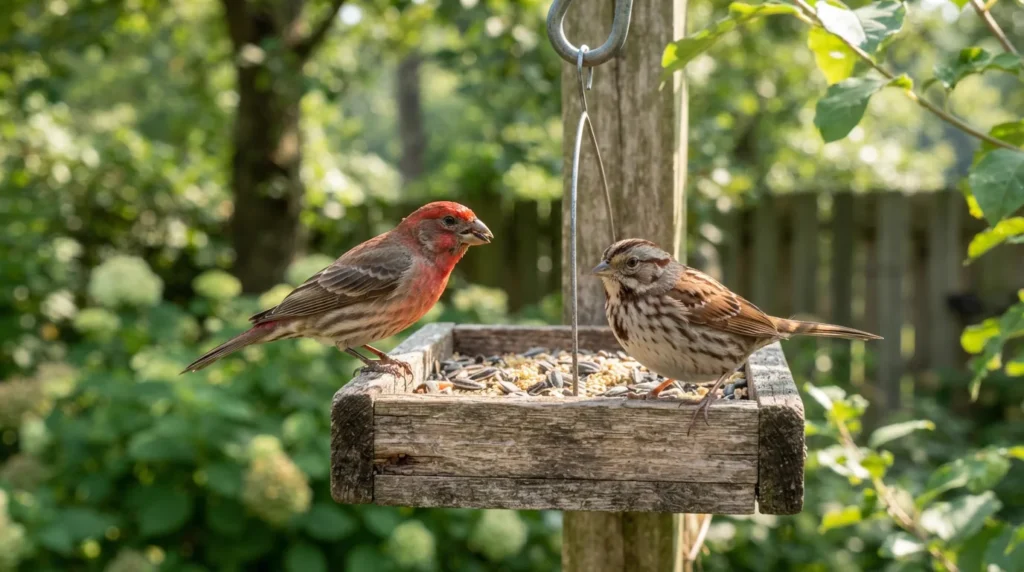
how to identify small brown backyard birds sparrows finches: Figuring out the identity of small brown birds bustling around backyard feeders can challenge even dedicated bird enthusiasts. When multiple species arrive together, telling them apart requires looking closely at subtle anatomical and behavioral differences to separate one bird from another.
Understanding these distinct field marks helps observers make sense of backyard visitors. For comprehensive guidance on recognizing common species in your outdoor space, consult Backyard Bird Identification: A Practical Guide to Recognizing Common Birds in Your Yard.
Core Structural Differences: Bills, Posture, and Flight
Finches and sparrows can be distinguished primarily by bill shape. Finches possess thick, stubby, conical bills built for cracking hard seeds, while sparrows have slightly thinner and more pointed bills. An important exception to note is that house sparrows possess heavy and blunt bills that are closer to finch proportions, causing frequent confusion with house finches. Despite this shared bill thickness, house sparrows belong to a completely separate family from New World sparrows, representing the Old World sparrow family Passeridae, whereas New World sparrows belong to the family Passerellidae. House sparrows were introduced to North America from Europe in the 1850s and are now considered invasive. Examining these structural features carefully allows birders to separate groups that otherwise appear superficially identical at first glance during busy morning feeding sessions.
Posture and behavior offer additional clues when identifying sparrows versus finches. Sparrows sit upright with their tails slightly raised or cocked, whereas finches perch more horizontally and hold their tails down. Furthermore, feeding habits differ between sparrows and finches; sparrows prefer ground-feeding and scratch in leaf litter and along path edges, while finches are comfortable on elevated perches and hanging feeders. Behavioral differences such as flight patterns also help identify sparrows and finches, as finches fly in a bouncy, undulating pattern using a flap-flap-glide rhythm, while sparrows fly in shorter, more direct bursts and drop into cover quickly. Observing these movements gives backyard birders reliable shortcuts when the birds refuse to stay still for a close look through binoculars.
When analyzing the structural differences between backyard bird families, observers must account for specific evolutionary outliers that do not follow general rules. While traditional identification guides rely heavily on slim, pointed bills to separate native sparrows from robust seed-eating finches, the presence of introduced species complicates this simplistic dichotomy. These structural anomalies require careful consideration of broader taxonomic relationships rather than relying solely on isolated physical features during busy feeding sessions.
Recognizing Common Backyard Finches
Plumage colors help differentiate finches from sparrows, with finches often showing red, yellow, or raspberry colors. For instance, female house finches are brown and streaky, while males feature a red breast and head, with exact red tints varying from blood red to orange or apricot depending on diet. Pine siskins are small finches similar in streaky brown plumage to female house finches, but uniquely possess yellow highlights in their wings and tails along with smaller, tapered beaks. By noting these subtle washes of color and specific beak dimensions, observers can accurately separate female house finches from pine siskins even when both visit hanging tube feeders simultaneously.
Goldfinches present distinct color patterns as well across different seasons and species types. Male lesser goldfinches are bright yellow with a black cap, whereas females are a duller green-yellow overall, and they particularly love shelled sunflower chips and Nyjer seed. American goldfinches are larger than lesser goldfinches and feature white feathers under the tail compared to yellow ones on lessers, while summer males are bright neon yellow with orange beaks and legs. These regional and seasonal variations reward patient observation, turning a flock of indistinguishable yellow birds into recognizable individual species.
Beyond basic bill measurements, chromatic variations within shared families provide essential diagnostic clues for backyard observers. Female house finches and pine siskins often present initial confusion due to overlapping streaky brown patterns, yet minute pigment highlights on the wings and specific beak proportions separate the two species reliably. Furthermore, goldfinches undergo dramatic seasonal plumage shifts that alter their yellow intensity throughout the year, rewarding patient birders who track subtle shifts in facial masks and under-tail coloration.
Distinguishing North American Sparrows by Head Patterns and Markings
There are 43 species of New World sparrows commonly found in the United States and Canada. In contrast to the bright colors of finches, sparrows tend toward brown, rufous, and gray with heavy streaking and bold face patterns. Examining specific facial features and breast markings clarifies these identifications for birders facing a confusing backyard mix.
The song sparrow possesses brown streaks on its chest that look painted and join together in a large central spot. The fox sparrow utilizes a ‘double scratch’ technique to find food, involving a foraging behavior where the bird jumps rapidly back and forth to uncover food in the underbrush. A quick glance at the face of a savannah sparrow reveals a wash of yellow color in the eye region, while the Lincoln’s sparrow possesses fine, sharp chest markings described as if drawn with a fine pencil, along with a contrasting buffy chest and throat sides. Each of these distinctive facial patterns and feeding techniques serves as a reliable field mark for separate identification.
The vesper sparrow features a complete white eye ring, and in flight, it displays white outer tail feathers, a characteristic compared to that of a junco. Other common species include the golden-crowned sparrow, which displays a dull yellow patch on its head during winter plumage, while its breeding plumage features a thick black eyebrow and bright yellow crown. White-crowned sparrows usually show bold black and white head stripes, though younger first-winter birds have brown and tan stripes, and all white-crowns possess yellowish-orange beaks. Dark-eyed juncos are smaller than crowned sparrows, featuring dark heads, brownish wings and flanks, a lighter tan belly, and characteristic dark eyes. Additionally, spotted towhees are black-headed, distinctively larger than juncos, and feature bold whites, reds, and namesake white spots on their black wings, whereas California towhees are large, chunky, and clumsy birds that are almost uniformly plain brown except for a rusty patch under their tail, and they typically remain on site in pairs all year round.
North American habitats host an exceptionally diverse array of native sparrows, demanding a focused examination of intricate facial markings and specialized foraging maneuvers. Observers dealing with dense backyard brush will often notice distinct behavioral quirks, such as the rapid double-scratch technique deployed by certain species to uncover hidden seeds in the leaf litter. Simultaneously, subtle cranial highlights like complete white eye rings, fine pencil-like chest markings, and washes of yellow near the eyes allow experienced naturalists to separate dozens of superficially similar brown birds with high confidence.
Mastering Your Backyard Bird Observations
Distinguishing small brown birds at your feeders becomes much more manageable when you focus on a few reliable field marks. By observing bill thickness, perching posture, flight style, and specific head or breast markings, you can confidently separate finches from native and introduced sparrows. Taking time to watch how a bird forages on the ground versus hanging from a feeder provides an immediate behavioral shortcut to correct identification, reducing frustration and deepening your connection to local wildlife.
Frequently Asked Questions About Sparrows and Finches
How can I quickly tell a sparrow from a finch at my feeder?
Look at the bill shape and feeding location. Finches have thick, conical bills for cracking hard seeds and prefer hanging feeders or elevated perches. Most sparrows have thinner, pointed bills and prefer foraging on the ground or scratching in leaf litter.
Why do house sparrows cause so much identification confusion?
House sparrows possess heavy, blunt bills that closely resemble finch proportions rather than the sleeker bills of native New World sparrows. This robust bill structure often leads observers to mistake them for finches.
Do finches and sparrows fly differently?
Yes, flight style is a reliable field mark. Finches travel in a bouncy, undulating pattern defined by a flap-flap-glide rhythm, whereas sparrows fly in shorter, direct bursts before dropping quickly into protective cover.
Are sparrows ground feeders or feeder birds?
Most sparrows prefer feeding on the ground, where they scratch through leaf litter and path edges for seeds and insects. However, some species will readily visit ground-level platform feeders or open seed trays.
Sources Consulted
- Sparrow Identification: How to Tell Sparrows from Finches
- Learn How to ID These 5 Confusing Streaked Sparrows | Living Bird | All About Birds
- Backyard Birds I: Finches and Sparrows – Nature in Novato
Research data retrieved on 2026-11-28 for Feather Yard Guide.
Get new guides by email
A weekly roundup when new guides are published. No daily emails.
Email confirmation required. Privacy Policy