
Backyard Bird Identification: A Practical Guide to Recognizing Common Birds in Your Yard can often feel overwhelming for beginner homeowners and bird enthusiasts faced with a wide variety of visiting species. By breaking down observation into manageable steps focusing on visual traits, behavior, and seasonal timing, recognizing your feathered visitors becomes an enjoyable and rewarding pastime.
Spring and summer are recommended as the best seasons to start identifying backyard birds because breeding plumage, active singing, and nesting behaviors make species much easier to spot and recognize before progressing to more challenging fall and winter plumages.
Best Seasons to Start and Essential Identification Tools
Starting your bird-watching journey during the warmer months gives you a front-row seat to active nesting and foraging behavior. To build your confidence, equipping yourself with the right tools is essential for accurate observation.
Region-specific bird identification field guides are useful tools for beginners, helping you learn typical local birds through color photographs or drawings, range maps, and detailed descriptions. In addition to traditional books, digital resources have revolutionized modern birding. The Merlin Bird ID app by the Cornell Lab of Ornithology is a recommended tool for bird identification, offering a fast and easy platform where users can answer five simple questions, upload a photo, or record sound to generate a list of likely species.
Recognizing Common Backyard Birds Across the United States
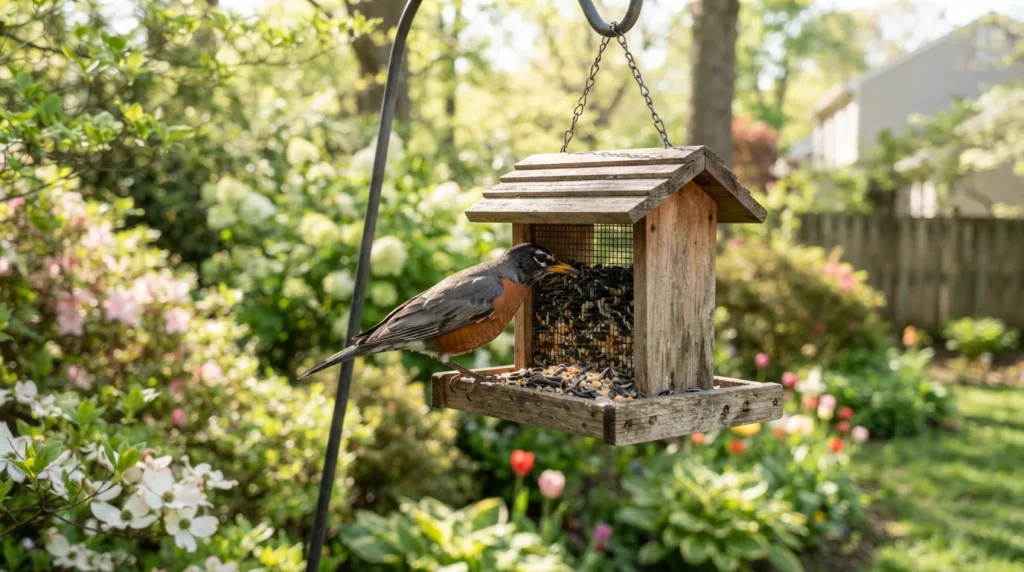
Once you have your field guide or app ready, learning a few widespread species will help anchor your observations. Across North America, the American Robin is widely recognized with its distinctive rusty orange belly and gray back, often spotted foraging on lawns.
In yards featuring trees and feeders, the Northern Cardinal offers a striking contrast; males are easily recognized by their black face and crimson crest, beak, and body, while females feature soft tawny feathers. Further east, Blue Jays are common year-round residents featuring a stunning pattern of black, white, and blue on the wings alongside a prominent crest. When reaching the Rocky Mountains, however, Blue Jays are replaced by Steller’s Jays, which feature contrasting blue lower bodies and black backs, heads, and crests.
Other frequent visitors include Mourning Doves, characterized by uniform brown-gray coloring, dark wing spots, a light-blue eye ring, and a sharp, pointed tail. Meanwhile, Black-capped Chickadees are easy to identify by their white cheeks sandwiched between a black cap and chin, accompanied by their characteristic namesake call.
Differentiating Visually Similar Backyard Species
One of the trickiest parts of bird identification is telling similar-looking species apart, particularly among woodpeckers and jays. Hairy and Downy Woodpeckers look almost exactly alike and share the same territory, but they can be differentiated by body and bill size. The Downy Woodpecker is the smallest and most abundant woodpecker species in the U.S., featuring a short bill and spotted outer tail feathers. By contrast, Hairy Woodpeckers are much larger with a thicker body, a heavier bill equal to the length of the head, and solid white outer tail feathers.
Observing Bird Behavior, Mimicry, and Habitats
Beyond colors and field marks, watching how a bird moves and interacts with its environment provides vital clues. The White-breasted Nuthatch is one of the more acrobatic backyard birds, frequently spotted skulking upside down along tree limbs and down trunks as it searches for insects.
Sound and mimicry also play major roles in identification. The Northern Mockingbird is a master mimic capable of imitating hundreds of bird songs and calls, as well as mechanical machinery and human sounds. Additionally, paying attention to seasonal arrivals can solve identification mysteries; Dark-eyed Juncos are colloquially known as snowbirds due to their sudden, widespread appearance throughout much of the country when colder weather arrives.
Frequently asked questions about backyard bird identification
How can I identify a bird nest found in my yard?
NestWatch provides a ‘Common Nesting Birds’ tool to help identify species that built an unknown nest. If you are still unsure, you can consult specific literature like A Guide to the Nests, Eggs, and Nestlings of North American Birds.
Can I send a photo of a bird nest to experts for help?
Yes, photographs of nests can be submitted to NestWatch for identification assistance by following specific guidelines. Send photos to their designated project email, capturing two or three angles, including eggs in at least one shot, stating your general region, state, or province and surrounding habitat, and optionally including a ruler for scale if safe.
How do I handle predatory birds like hawks visiting my feeders?
If a Cooper’s hawk starts regularly visiting backyard feeders for prey, taking the feeders down for a few days will cause it to move on safely.
Summary and Next Steps for Backyard Birders
Mastering backyard bird identification relies on combining visual field marks, seasonal changes, behavioral traits, and reliable resources like regional field guides and the Merlin Bird ID app. By starting during the active spring and summer months, you can gradually build your familiarity with local species without feeling overwhelmed. Your next practical step is to spend just ten minutes a day quietly observing your yard, noting the shapes, colors, and behaviors of visiting birds, and checking your observations against a trusted field guide or app.
Sources consulted
- How can I identify what kinds of birds are in my backyard? – NestWatch
- Get to Know These 20 Common Birds | Audubon
- Common Midwest Backyard Birds: IDs, Tips and Fun Facts
Research data governed on 2026-10-19 for Feather Yard Guide.
Get new guides by email
A weekly roundup when new guides are published. No daily emails.
Email confirmation required. Privacy Policy