
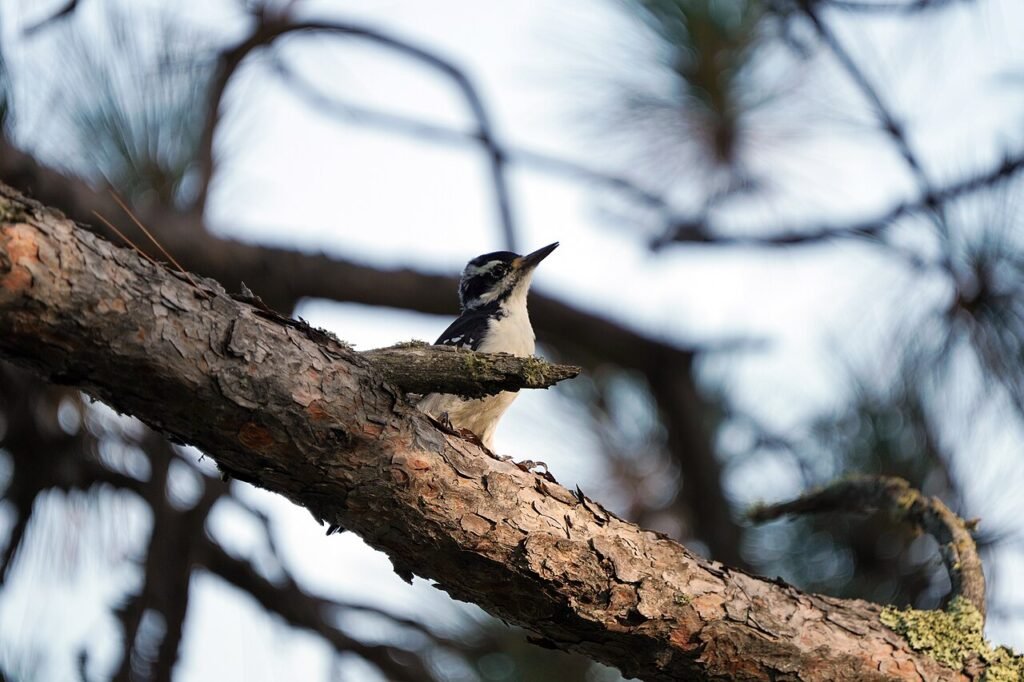
Quick answer: For a Downy vs Hairy Woodpecker comparison, look at the bill in relation to the head. A Downy Woodpecker has a short, delicate-looking bill, often about one-third the length of its head. A Hairy Woodpecker has a noticeably longer, sturdier bill that approaches the length of its head. Size and tail markings provide useful supporting clues, but both species have similar black-and-white plumage and small red head patches on adult males. Use several field marks together, especially when the bird is far away.
These two North American woodpeckers are a classic identification challenge for backyard birders. Both cling to tree trunks, visit suet feeders, and show a striking black-and-white pattern with a white stripe running down the back. A quick sighting can therefore feel like looking at the same bird in two different sizes. The differences are real, though, and the Cornell Lab Bird Academy comparison offers a practical way to learn them without guessing from color alone.
Downy vs. Hairy Woodpecker: identification at a glance
Use this table as a field reference. Individual birds vary, and some marks are not visible in every photo or geographic region.
On a phone, swipe the table sideways to see all columns.
| Clue | Downy Woodpecker | Hairy Woodpecker |
|---|---|---|
| Typical length | About 5.5–6.7 inches; small and compact | About 7.1–10.2 inches; substantially larger on average |
| Bill compared with head | Short, roughly a third of head length in many views | Longer, approaching head length |
| Outer white tail feathers | Usually show some black spots or bars | Often unmarked white in eastern birds; some western and Newfoundland birds have barring |
| Overall structure | Smaller bill, compact body and head | Heavier-looking build and long chisel-like bill |
| Adult male red mark | Red on back of head; not unique to Downy | Red on back of head; not unique to Hairy |
| Typical habitat impression | Backyards, parks, brushy edges, small branches | Larger trees, mature woods, wooded parks and edges |
| Call | High-pitched pik and a descending whinny | Strong peek and a rattling call that typically does not descend at the end |
Measurements and regional exceptions are drawn from the Cornell Downy Woodpecker identification guide, the Cornell Hairy Woodpecker identification guide, and Cornell Bird Academy’s side-by-side lesson. The exact measurements overlap somewhat; do not identify a distant bird by estimated inches alone.
Compare the bill with the head first
The bill is usually the quickest and most reliable visible distinction when you can see a side profile. Downy Woodpeckers have a relatively small bill that appears delicate for the size of the head. Hairy Woodpeckers have a more imposing, straight, chisel-like bill that looks nearly as long as the head from the base to the back.
How to judge proportions without a ruler
Look at a side-on photograph or watch the bird pause on a trunk. Imagine the space from the front of the eye to the back of the head, then compare that scale with the length of the projecting bill. A Downy often looks as though it has a short pencil tip; a Hairy looks as though it has a much longer pointed tool. The Audubon identification comparison emphasizes this difference because actual body size can be difficult to judge at a distance.
A photograph taken straight on can make both bills appear short. A bill partly hidden by bark, a branch, or a feeder port is equally unhelpful. Wait for another angle rather than guessing based on a distorted view. If the bill is not visible, move to overall size and tail markings.
Are both birds equipped to drill into wood?
Yes. Both belong to the woodpecker family and have bills suited to probing, pecking, and working on wood, although exact feeding techniques and preferred surfaces vary. The shape and proportion of the bill help with identification; they do not by themselves tell you what insect or other food a bird is seeking. Watching the bird’s behavior can supply additional context.
Use overall size only when you have a reference
A Downy Woodpecker is usually much smaller, with a typical body length of roughly six inches. A Hairy Woodpecker is commonly around nine inches, although Cornell gives a wider measurement range and sizes vary geographically. A Downy is a smaller woodpecker that may seem close to sparrow-sized; a Hairy more often gives a robin-sized impression.
That difference is obvious when the two species happen to be side by side but less obvious when a single bird occupies a trunk at an unknown distance. Camera zoom, bird posture, and the diameter of nearby tree limbs all affect your perception. Use a known perch, bird feeder, or branch for scale if the object is at the same distance as the bird.
Why a small-looking bird may still be a Hairy
A Hairy Woodpecker viewed far across a backyard can appear smaller than a nearby Downy. Juveniles and birds from different parts of the continent also vary in size. Rather than relying on a mental ruler, combine body proportions with the bill, tail, and habitat. If those clues disagree, record your identification as uncertain.
Inspect the white outer tail feathers—carefully
When you have a good view of the underside or outer edges of the tail, look for dark marks on the white feathers. Downy Woodpeckers typically show black spots or bars on these outer feathers. Many Hairy Woodpeckers—especially eastern birds—have white outer tail feathers that appear clean and unmarked.
Important exception: an all-white tail is not an absolute species test. Cornell Bird Academy explains that some Hairy Woodpeckers from the Pacific region and Newfoundland also show dark barring on outer tail feathers. Tail patterns can also disappear from view when the bird braces its tail against bark. Use this clue to support the bill and size, not to overrule them.
What if I cannot see the tail spots?
That is common. The bird may be perched with its back toward you or using its stiff tail for support. Do not approach aggressively or make the bird fly simply to see another field mark. You can often wait quietly for the bird to move to the other side of a trunk, then compare the bill and head instead.
Check the shared black-and-white pattern
Downy and Hairy Woodpeckers often show much the same broad design: black wings spotted with white, black-and-white head stripes, white underparts, and a white central stripe on the back. Those similarities are one reason this pair is so frequently confused. A black-and-white back pattern alone rarely settles the identification.
Does a red patch mean it is a male?
Adult males of both species commonly have a small red patch at the back of the head, or nape. Adult females generally lack that red nape patch. Because both adult male species can show red, the patch does not answer the Downy-versus-Hairy question. Young birds can differ from adults, sometimes showing red on the crown, so age and plumage matter as well. Refer to the original Downy and Hairy photographic guides for examples of males, females, and juveniles.
Do western birds look different?
Yes. Cornell’s regional notes describe darker Pacific populations and differences in wing spotting and facial stripes across the continent. An identification checklist built entirely from eastern photographs may be misleading for a bird in coastal Washington, Oregon, or parts of the interior West. Look for region-specific photographs before assuming a missing or different-looking mark is impossible.
The Cornell comparison also describes a dark, comma-like mark near the shoulder that can be more clearly defined in some Hairy Woodpeckers. This is a supplemental clue for good views, not a replacement for bill length and overall structure.
Listen for the call, but verify its source
Both birds call and drum, and many of their sounds are similar. Downy Woodpeckers can make a high pik note and a quick descending whinny that drops in pitch. Hairy Woodpeckers make a sharp peek, often lower or stronger sounding, and a rattling sequence that typically does not descend toward the end. The difference becomes more useful after you have listened to a variety of verified recordings.
Compare the original Cornell sound libraries: Downy Woodpecker sounds and Hairy Woodpecker sounds. These include multiple call types; not every bird will vocalize in the same way during your observation.
Is drumming a foolproof identification clue?
No. Both sexes of both species can drum on wood and other resonant surfaces for communication. Speed, length, and rhythm differ on average, but hearing a drum through a window or across a street may not provide enough evidence for a confident identification. Note the sound and location, then look for the bird rather than forcing a species name.
Habitat and feeding behavior help narrow the options
Downy Woodpeckers are common visitors to residential yards, city parks, orchards, brushy edges, and open woods. They often work smaller branches and plant stems and may forage acrobatically in places that a larger woodpecker could find less convenient. Cornell describes Downies balancing on slender branches and even some tall weeds.
Hairy Woodpeckers tend to be associated with larger trees, mature woodland, forest edges, and wooded parks, although they also visit suburban areas and feeders. They may climb substantial trunks and larger branches while searching for insects. Habitat changes the likelihood of a species, but neither is restricted to a single kind of tree or neighborhood.
What if both visit the same suet feeder?
That can happen where the ranges overlap. Watching a bird eat suet does not establish whether it is Downy or Hairy. A suet feeder can, however, provide a known object for size comparison and a moment when the bird turns its head, revealing the bill. Be patient and avoid moving closer if the bird seems uneasy.
Feeding should also be responsible. If you maintain suet or seed stations, keep equipment clean, avoid spoiled food, and reduce window and pet hazards. Our published guide to safe backyard bird feeding covers these general precautions without repeating them here.
Check your U.S. region and the season
Both species have broad North American distributions, but their relative abundance and specific habitat use vary among regions. Downy Woodpeckers often occur in wooded residential areas where there are suitable trees. Hairy Woodpeckers also occur in many of these regions but can be less conspicuous or more associated with larger wooded habitat.
Use the Downy Woodpecker range map and Hairy Woodpecker range map to assess which species are plausible in your area and season. A broad national range map does not guarantee either bird will visit your yard; local vegetation, urbanization, and observer coverage matter.
If a bird seems unusual for your neighborhood, take careful notes and compare several original images rather than treating a rarity as a certainty. An identification app may suggest possibilities, but a brief sound recording or single photo may not capture the diagnostic marks.
How to identify one from a quick photo
You can make a useful identification from a clear phone or camera image, but avoid claiming certainty when the key marks are hidden. Try this order:
- Check the bill angle. Is the bird side-on enough to see bill length relative to the head?
- Compare proportions. Does the bill look short and fine or long and nearly head-length?
- Estimate body size. Use a feeder or branch at the same distance rather than guessing from the zoomed picture.
- Inspect the outer tail. Look for dark spots, keeping regional exceptions in mind.
- Note the date and location. Check region-specific plumage and seasonal likelihood.
- Compare trustworthy photos. Use Cornell’s species galleries and, when available, verified local observations.
- State confidence appropriately. If the key features are obscured, use “Downy/Hairy Woodpecker” or a broader unidentified woodpecker label rather than making up details.
A photo that shows the bill clearly may be more useful than a beautiful but distant back view. Never disturb a nest or chase a bird just to improve the image. Ethical observation is more important than completing a checklist.
Common identification mistakes to avoid
- Choosing by the red head patch: adult males of both species can have red on the nape.
- Guessing from distance alone: camera magnification can make a Downy look larger or a Hairy look smaller.
- Using tail spots as an absolute rule: some Hairy Woodpeckers have barred outer tail feathers in particular regions.
- Ignoring juveniles: head markings on young birds may differ from typical adult patterns.
- Assuming every yard visitor is Downy: a Hairy Woodpecker can visit feeders and suburban trees.
- Depending entirely on an app: review the original observations, not only a suggested species name.
- Overlooking other woodpeckers: western and southern regions have additional black-and-white woodpecker species to consider.
Frequently asked questions
What is the easiest difference between a Downy and Hairy Woodpecker?
Bill length relative to the head is usually the best first check. Downy has a short, relatively delicate bill; Hairy has a longer bill approaching head length. Confirm with size, tail, habitat, and region.
Is a Hairy Woodpecker just a larger Downy Woodpecker?
No. They are two separate species with different proportions and natural histories. They look remarkably alike, but there are consistent average differences in bill shape, size, and some other field marks.
Does a Downy Woodpecker always have spots on its tail?
Many Downy Woodpeckers show black spots or bars on their white outer tail feathers, but marks may be hidden by the viewing angle or feather position. And some Hairy Woodpeckers in certain regions also show barring, so the tail is not a perfect stand-alone test.
Can both species visit the same bird feeder?
Yes. Both may visit a suet feeder or wooded backyard. Feeder choice, location, and season affect which birds appear, but the food itself does not determine the species. Look at the bill and overall structure while the bird is perched.
Can I identify them by sound alone?
Sometimes, especially with experience and a clear recording of the characteristic calls. But their sounds can overlap, and background noise can mislead you. Compare several verified recordings and visual clues before making a confident identification.
Bottom line
For the Downy vs. Hairy Woodpecker question, the bill-to-head proportion is the strongest place to start. A Downy is generally smaller and shorter-billed; a Hairy is generally larger, with a bill nearly the length of its head. Spots on outer tail feathers, sound, habitat, and region can support your decision, but each has limitations. Be willing to leave a difficult sighting unidentified until you have enough evidence.
Sources and further reading
- Cornell Bird Academy — Downy and Hairy Woodpeckers.
- Cornell Lab of Ornithology — Downy Woodpecker Identification.
- Cornell Lab of Ornithology — Hairy Woodpecker Identification.
- National Audubon Society — How to Tell a Hairy Woodpecker From a Downy Woodpecker.
- Cornell Lab — Downy Woodpecker Sounds.
- Cornell Lab — Hairy Woodpecker Sounds.
- Cornell Lab — Downy Woodpecker Range Map.
- Cornell Lab — Hairy Woodpecker Range Map.
Editorial note: This educational comparison uses published bird-identification guides and does not claim original field observations, diagnostic certainty from AI-generated images, or professional wildlife handling. Regional appearance and seasonal occurrence vary. Sources reviewed October 2026. See our research process for editorial standards.








Get new guides by email
A weekly roundup when new guides are published. No daily emails.
Email confirmation required. Privacy Policy